The Tribute Journal
Eulogy for a Grandmother: 6 Examples to Copy
A eulogy for a grandmother is a short speech, usually two to five minutes, that tells the people in the room who she was through one or two true stories. You do not need to cover her whole life; the obituary does that. Below are six complete eulogies to adapt, a structure that works every time, and the practical details: how long to speak, what to check first, and how to get through it.
The word comes from the Greek word eulogia, which Wikipedia notes means "praise." That is the whole job: praise her, honestly, with the details only her family knows. For the general method, see how to write a eulogy.
A simple structure that works
- Say who you are. "I'm Sarah, the oldest of her eleven grandchildren." Half the room may not know you.
- Give one picture of her. Her kitchen, her garden, the chair she always sat in. Something everyone can see.
- Tell one story. One specific memory, told well, says more than a list of her virtues.
- Say what she taught you. What do you still do because of her?
- Say goodbye. A short last line spoken to her directly, or a line from a poem or scripture she loved.
Check these before you write
- Whether a eulogy is part of the service. Wikipedia notes that "some denominations either discourage or do not permit eulogies at services." At a Catholic funeral Mass, for example, remarks are often kept brief or moved to the vigil or the reception. Ask the officiant. Our guide to the Catholic funeral program shows where they usually fall.
- What the family wants included, or left out. Emily Post advises asking the family "if there is anything they feel should be mentioned or not mentioned."
- Who else is speaking. The same guide suggests asking "what other speakers will be covering to help avoid either repetition or leaving something out."
1. A short eulogy (about two minutes)
Good morning. I'm Emily, Grandma Rose's oldest granddaughter.
If you ever went to Grandma's house, you know the first thing she did. Before you had your coat off, she asked if you were hungry. It did not matter what you said. Five minutes later there was a plate in front of you.
That was how she loved people. Not with speeches, but with food, with attention, with showing up. She came to every one of my school plays, sat in the front row, and clapped louder than anyone, even the year I played a tree.
She taught me that you do not have to be important to make someone feel important. You just have to pay attention.
Grandma, thank you for every plate, every phone call and every front-row seat. We will keep setting a place for you.
2. A warm and funny eulogy
Hi everyone. I'm Michael, one of Nana's nine grandchildren, and before anyone asks, yes, I was her favorite. So were the other eight. She told every one of us, separately, and she meant it every time.
Nana had rules. You did not leave her house without leftovers. You did not say no to a second slice of pie. And you absolutely did not let her lose at cards, because she would know, and she would be offended. She played gin rummy like it was a contact sport, and she was still beating me last Christmas.
She also had a laugh you could hear from the driveway. It was the best sound in the world, and I am going to miss it more than anything.
But the thing I will remember most is how she made every single one of us feel like we were the most interesting person she had ever met. She asked questions and actually listened to the answers.
Nana, I promise to keep playing cards with the kids. And I promise to let them win, at least sometimes.
3. A faith-filled eulogy
Good afternoon. My name is James, and Grandmother Ruth was my grandmother, my Sunday school teacher and my prayer warrior.
Every morning of my life, Grandmother prayed for me by name. I know because she told me, and I know because when things went wrong, she was the one who called before I had told anyone. She said the Lord woke her up thinking about me.
She read her Bible at the kitchen table every day, the pages so worn the corners were soft. She underlined in pencil and wrote dates in the margins, and when we looked through it this week we found our names written beside the verses she prayed over us.
She used to say, "I am not afraid of going home. I just want to make sure you're all coming too."
Grandmother, you fought the good fight, you finished the race, you kept the faith. Rest now. We will see you again.
4. For a grandmother who raised you
Good morning. I'm Danielle. Most of you knew her as Mrs. Lorraine Davis. I knew her as Grandma, and for most of my life, she was also my mother.
When I was six, she took in my brother and me without a second thought. She was sixty-one, she had already raised five children, and she did it all again: the homework, the doctor's appointments, the field trips, the curfews she enforced from her recliner with one look.
She never once made us feel like a burden. When I asked her years later how she did it, she said, "Baby, love doesn't count."
Everything good in my life, I learned at her kitchen table. How to work hard. How to keep my word. How to forgive people and still keep my standards.
Grandma, you gave up your rest so we could have a home. I hope you are resting now. Everything I do from here, I do with your name in my heart.
5. For a great-grandmother who lived a long life
Thank you all for being here. I'm Patricia, Grandma Helen's granddaughter, speaking for all twenty-six of us: her grandchildren and great-grandchildren.
Grandma Helen was born when there were still horse-drawn wagons on her street, and she lived long enough to video-call her great-grandchildren in three time zones. She took every change in stride, and she was curious about all of it.
She raised four children through hard times, buried a husband she adored, and still found reasons to laugh every single day. When we asked her the secret to a long life, she always gave the same answer: "Stay busy, stay kind, and don't worry about what you can't fix."
Each of us carries something of hers: her recipes, her stubbornness, her habit of humming while she cooks.
Grandma, ninety-seven years was not enough, but it was a gift. Thank you for every one of them.
6. From a teenage grandchild
Hi. I'm Ava, and I'm fifteen. Grandma Linda was my best friend.
Every Saturday she picked me up and we did the same thing: breakfast at the diner, then the craft store, then her house to make something we usually did not finish. I have a whole drawer of half-done projects, and I'm never throwing them away.
She was the only adult who never told me I was on my phone too much. Instead she asked me to show her what I was looking at, and then she wanted to learn it. She had a better playlist than me.
She always said, "Be brave, be kind, and wear sunscreen." I'm going to try to do all three.
I love you, Grandma. Thank you for every Saturday.
If a younger grandchild wants to speak
Children often want to read something short: a memory, a drawing described aloud, a poem. Let them, if they truly want to, and keep it to a few sentences. The Child Mind Institute notes that with children and funerals "there's no right or wrong thing to do. Instead, it's very context-dependent," and advises parents to "set aside time to prepare her for the experience. Describe what it will be like." An adult standing beside them at the lectern makes it far easier.
Getting through it on the day
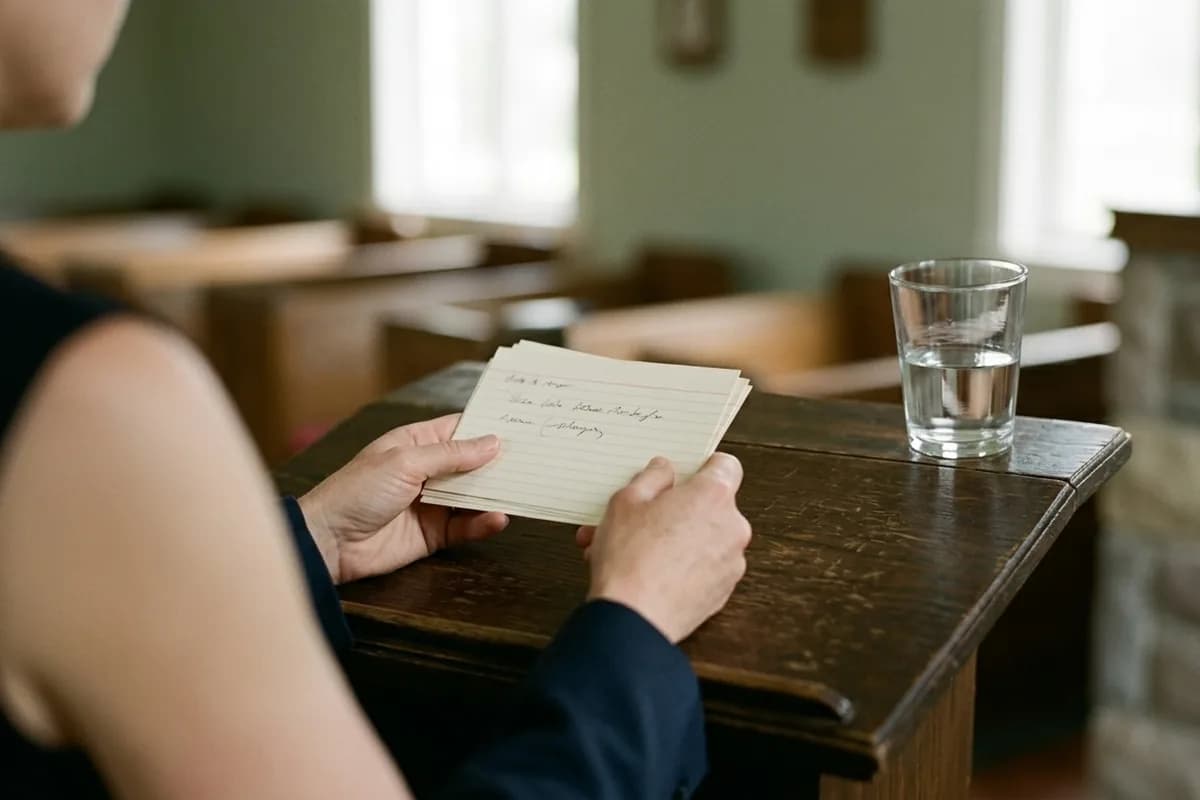
- Print it large. Emily Post's first delivery tip: "print your eulogy out in extra-large font so it will be easy to read." Double-spaced, numbered pages.
- Read it aloud three times beforehand. The places where your voice catches will not surprise you on the day.
- Mark a pause after the hardest line. Stopping to breathe is not failing. Everyone in the room understands.
- Have a backup reader. Give a sibling or cousin a copy. If you cannot finish, they can, and that is fine.
- Keep a short reading in reserve. One of the funeral poems she loved works if you need to close quickly.
Common questions
How do you write a eulogy for a grandmother?
Say who you are, give one clear picture of her, tell one specific story, say what she taught you, and end with a short goodbye spoken to her. Write it the way you talk, not the way you write, and read it aloud before the day.
How long should a eulogy for a grandmother be?
The Emily Post Institute's guidance is no less than two minutes and no longer than eight to ten, and shorter when several people are speaking. For a grandchild among several speakers, two to four minutes is ideal.
Can a grandchild give the eulogy?
Yes, and it is often the most moving part of the service. Check with the family and the officiant first, since some denominations discourage eulogies during the service itself, and agree with other speakers who will cover what.
Is it okay to include humor in a eulogy?
Yes, if she was funny and the family is comfortable with it. Emily Post advises handling humor "with care for how it may be received by all." Gentle, loving stories work; jokes at anyone's expense do not.
What if I cry during the eulogy?
Pause, breathe and continue when you can. Nobody minds. Give a backup copy to a sibling or cousin so they can finish for you if needed.
What is the difference between a eulogy and an obituary?
An obituary is written, published in the newspaper and the program, and covers the facts of a whole life. A eulogy is spoken at the service and is personal: one or two stories that show who she was to the people who loved her.