The Tribute Journal
8 Eulogy Examples You Can Adapt
A eulogy is three to five minutes of speaking — roughly 500 to 800 words. That is shorter than people fear and long enough to say what matters. Below are eight complete examples in different registers. All names are invented; swap in your own details and the shape holds.
1. For a father
My father was not a man of many words, which makes standing here saying a lot of them feel slightly against his wishes. He worked thirty-eight years at the same plant. He left the house at 5:40 every morning and I never once heard him complain about it. When I was fifteen and told him I hated my summer job, he said, "Good. Now you know what you're working to get away from." That was the whole conversation. It shaped the next twenty years of my life. He taught me to change a tyre, to shake hands properly, and to never let anyone leave the house hungry. He came to every game. He sat in the same corner of the stand, and he never shouted once, and I could always find him. He was proud of us. He didn't say it, but he told other people, and they told us, which I think was his plan all along. Dad, we've got it from here. Thank you for everything. Rest now — you've earned it.
2. For a mother
If my mother were here, she would want me to tell you there is food in the back and to please take some home. Mum fed people. That was how she said everything she found hard to say out loud. Worried about you? Casserole. Proud of you? Casserole. It was a whole emotional vocabulary conducted through the oven. She raised four of us on very little and none of us knew it at the time, which I now understand was an extraordinary act of engineering. She worked nights at the surgery for nineteen years so she could be there when we got home. She had a way of asking "and how are you really?" that made lying impossible. Half the people in this room have been on the receiving end of that question. Some of you are nodding. She was the warmest room any of us will ever stand in. Mum — thank you. We'll take care of each other. That's the only thing you ever asked for.
3. For a grandparent
My grandmother was born in 1934 and had opinions about all of it. Gran's house smelled of baking and furniture polish, and the good biscuits were kept on a shelf we were told not to reach and always reached. She let us. That was the arrangement — she pretended not to see and we pretended she hadn't. She taught me to play cards properly, which meant playing to win, including against a nine-year-old. I did not beat her until I was twenty-two. She did not let me. What I understand now, that I didn't then, is that she had lived through a great deal and chose to be light anyway. That was a decision she made every day, and she never once mentioned it. Gran, thank you for the biscuits, the cards, and the example. We'll be playing to win.
4. For a spouse or partner
Forty-one years ago, a woman at a bus stop told me I was standing in the wrong queue. She was correct, as she would remain for the next four decades. We built a life out of very ordinary things. Tuesday shopping. The same walk on Sunday. An argument about the thermostat that ran, unresolved, for thirty-nine years. People talk about love as though it is a feeling. Ours was mostly a series of small choices — she chose me on days I was hard to choose. I hope she felt chosen back. When she was ill she apologised for being trouble. She was never trouble. She was the whole point. My love — I don't know how to do the Sunday walk yet. I'll learn. Thank you for the life.
5. For a sibling
My brother and I did not speak for most of 1998, over something I am now certain was his fault and he was certain was mine. Neither of us can remember what it was. That was us. Two years older, endlessly infuriating, and the first person I called when anything went wrong. He was funnier than me, which I resented, and kinder than me, which I resented more. He rang our mother every Sunday without being asked. He remembered everyone's children's names. The thing about a sibling is they hold the only other copy of your childhood. There are stories that now nobody alive can confirm. I'll keep telling them anyway, and I'll make myself the hero, and he'd have expected nothing less. Love you. Sorry about 1998. It was probably me.
6. For a close friend
I met Danny on the first day of secondary school. He had already been sent out of a lesson. We were eleven. Thirty years later he was still the person who made a bad day survivable. He had an unshakeable belief that any situation could be improved by getting a coffee and talking it through, and he was almost always right. He was the friend who turned up. When my father died he drove three hours, said almost nothing, sat with me, and drove home. I've never forgotten it and I never told him. So I'm telling all of you. He collected people. Look around this room — most of us only know each other because of him. Dan, thanks for turning up. Every time.
7. A very short eulogy
Around 150 words, for when you are asked at short notice, or when speaking at length is beyond you today. This is completely acceptable and often more moving than something longer.
I'm Sarah, Margaret's niece. Aunt Margaret sent birthday cards. Every year, to everyone, always arriving the day before — never late, never on the day. Twenty-two of us. She never missed one. That sounds small. It isn't. It means that every single year, twenty-two people were reminded that somebody was keeping track of them. That was her whole way of being in the world. Quiet, consistent, and impossible to replace. We'll miss the cards. We'll miss her more. Thank you.
8. When the relationship was complicated
Not every death is a simple loss. You can be honest without being unkind — and a room full of people who knew the person will trust you more for it.
My father and I had a complicated relationship, and I think he would rather I said so than pretend otherwise. He was not an easy man. He could be sharp, and he could hold a grudge across years. Some of you in this room know that better than I do. He was also the man who taught me to swim, who fixed my first car at midnight before a job interview, and who, near the end, said some things I had waited a very long time to hear. I've decided to keep both versions. Softening him would be a kind of lie, and he had no patience for those. Dad, I hope you found some peace. I'm glad we got the last conversation. Rest well.
Practical notes for the day
- Print it large. 14pt or bigger, single-sided, numbered. Do not read from a phone — the screen dims and your hands shake more than you expect.
- Read it aloud twice beforehand. Once alone, once to another person. You will find the sentence that does not work.
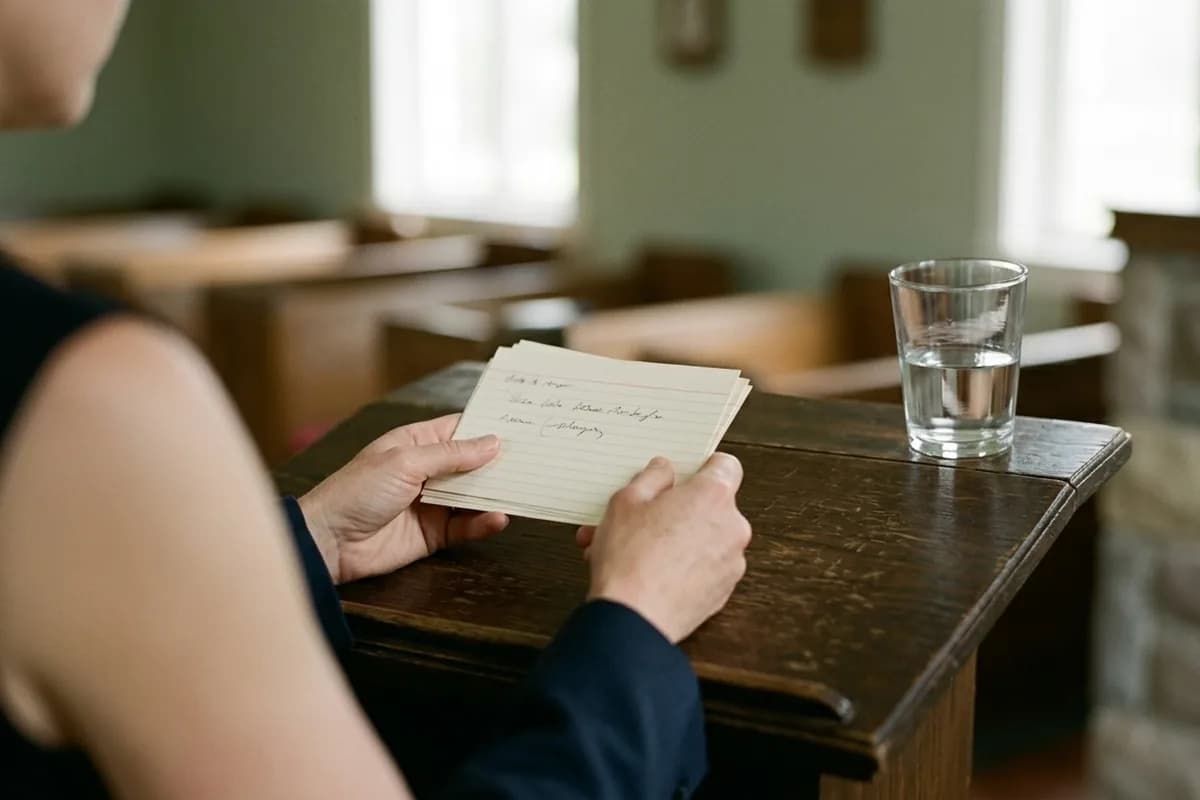
- Put a glass of water on the lectern. Ask someone to.
- Pause where you need to. Nobody is timing you and silence in a eulogy reads as feeling, not failure.
- Ask a back-up. Give a copy to one other person who is willing to finish it if you cannot. Knowing they have it usually means you won't need them.
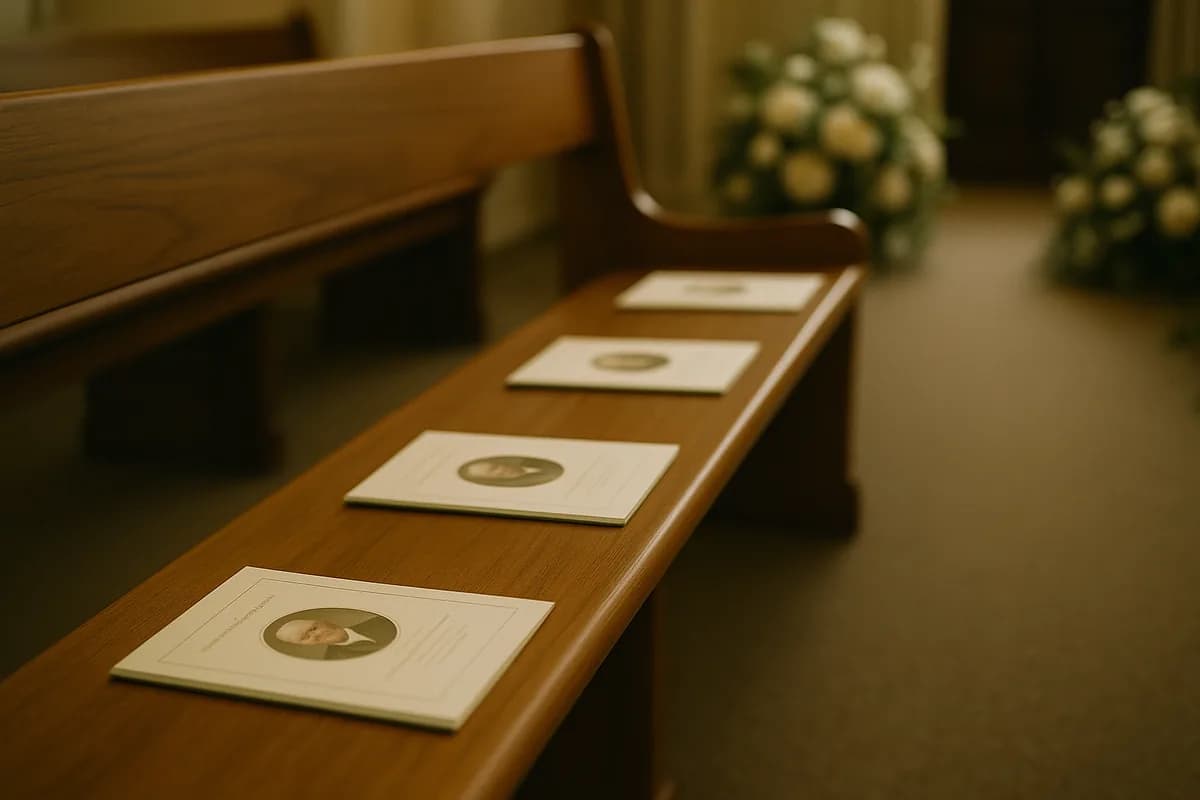
If you would rather build yours from scratch, our step-by-step guide on how to write a eulogy covers gathering material and structuring it. And the speaker's name belongs in the printed order of service — see what to include in a funeral program.
How long should a eulogy be?
Three to five minutes, which is roughly 500 to 800 words spoken at a natural pace. Under two minutes is fine if that is what you have in you; over ten begins to lose the room.
How do you start a eulogy?
Say who you are and how you knew them — "I'm Sarah, Margaret's niece." It orients a room where many people don't know each other, and it gives you a simple first sentence to get through.
Is it okay to be funny in a eulogy?
Yes, if the humour is about who they were rather than performed for the room. Laughter at a funeral is a relief, not a betrayal — just avoid anything that requires a private context to land.
What if I cry and can't finish?
It happens constantly and nobody minds. Pause, breathe, drink water. Give a copy to someone beforehand who can step in — knowing there's a safety net usually means you won't need one.