The Tribute Journal
7 Funeral Order of Service Examples (Ready-to-Use Templates)
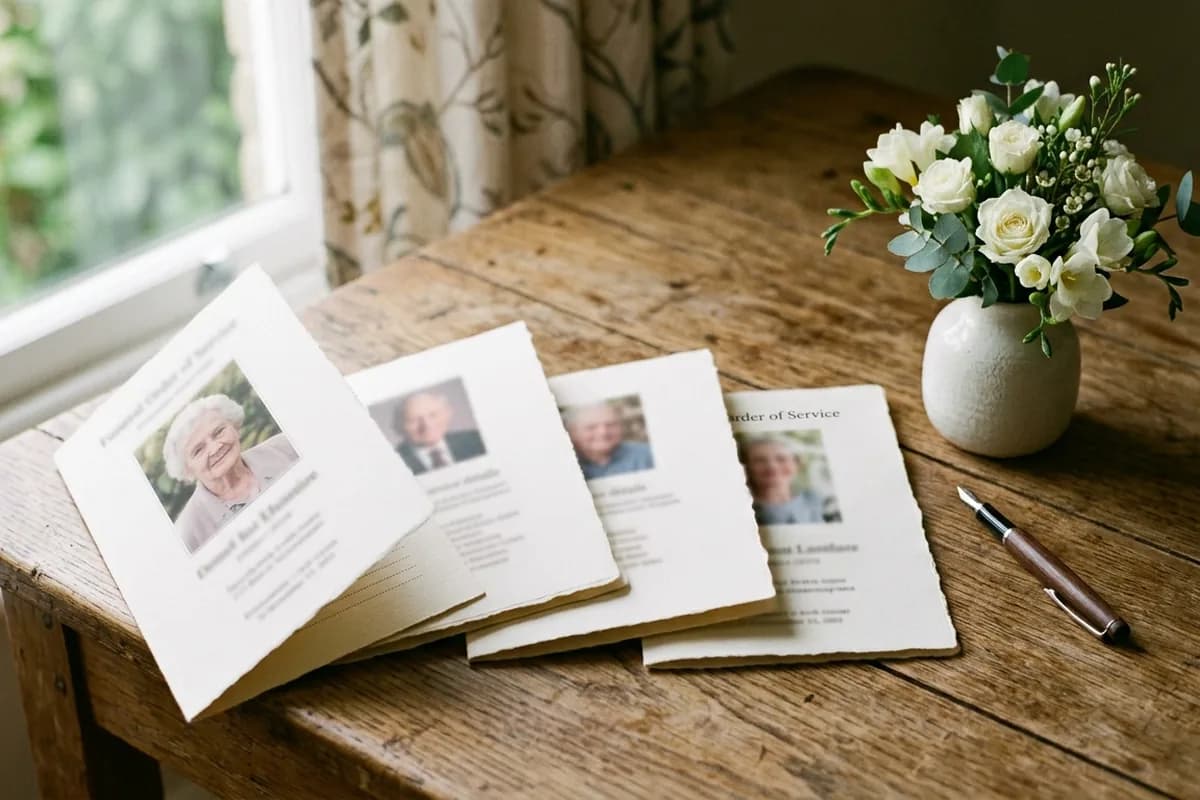
The order of service is the spine of a funeral program — the sequence that tells guests what is happening and when to stand, sing, pray, or simply listen. There is no single right order; it flows from the faith, the family, and the person being honored. Below are seven complete examples you can copy and adapt directly — traditional Christian, Catholic Mass, celebration of life, non-religious, graveside, memorial service, and military honors. Treat them as starting points, not rules: add, remove, and reorder until the sequence fits the service you are planning.
If you have not yet decided on a format for the program itself, our overview on how to make a funeral program covers sizes and layout first — and our sample funeral programs show the complete printed piece, cover and back panel included, not just the order of service.
Example 1: Traditional Christian service
A widely used Protestant order, suitable for most non-denominational and mainline Christian services. It moves from gathering, through the word and remembrance, to committal and sending. For the African American church tradition, with resolutions and a fuller musical order, see our guide to the homegoing service.
- Musical Prelude
- Processional
- Opening Words & Welcome — Officiant
- Opening Hymn — e.g. "Amazing Grace"
- Prayer of Comfort
- Scripture Reading — e.g. Psalm 23
- Eulogy / Words of Remembrance
- Musical Selection or Solo
- Second Reading or Poem
- Message of Hope — Officiant
- Closing Prayer & Benediction
- Recessional
- Committal (graveside)
Example 2: Catholic Funeral Mass
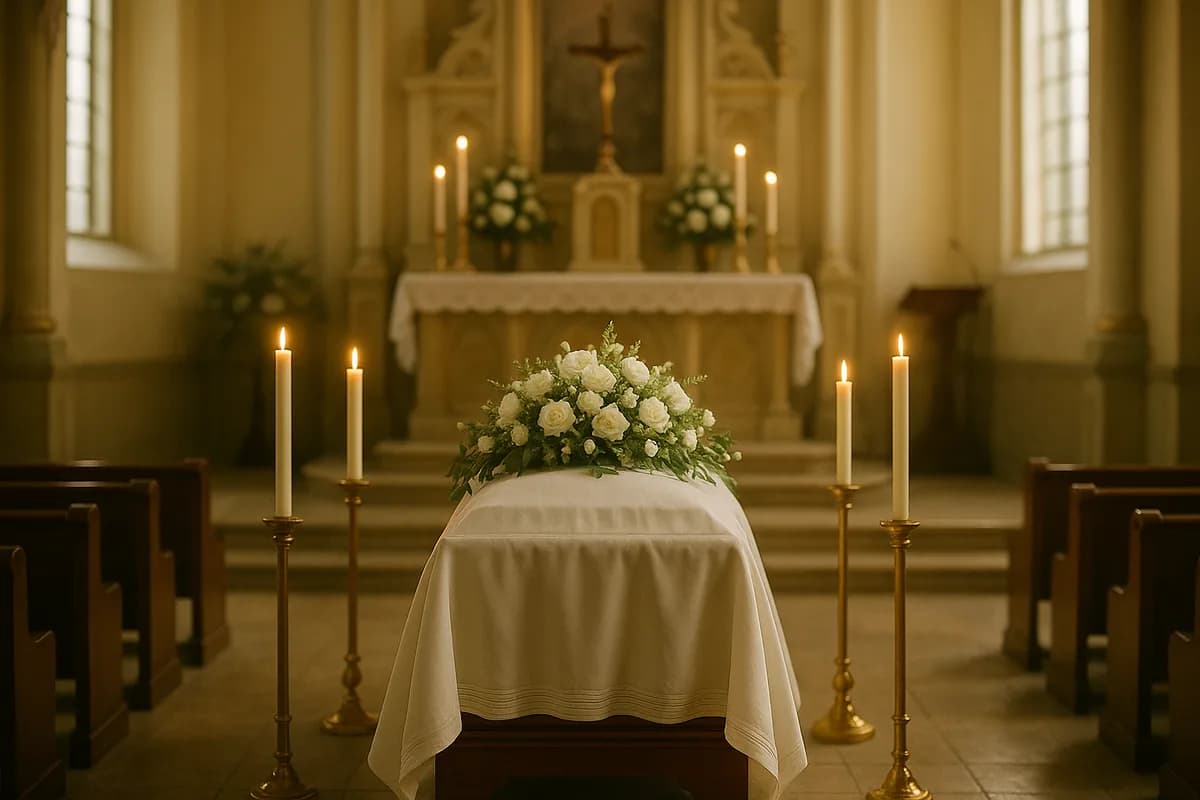
A Catholic Funeral Mass follows a fixed liturgical structure. The program should reflect it accurately so guests — Catholic or not — can follow along with confidence.
- Reception of the Body & Greeting
- Placing of the Pall
- Entrance Procession & Opening Hymn
- Opening Prayer (Collect)
- Liturgy of the Word — First Reading
- Responsorial Psalm
- Second Reading
- Gospel Acclamation & Gospel
- Homily
- General Intercessions (Prayers of the Faithful)
- Liturgy of the Eucharist — Offertory, Eucharistic Prayer, Communion
- Final Commendation & Farewell
- Recessional
Because the Mass has parts guests are invited to say or sing together, many Catholic programs print short responses inline. Our dedicated Catholic funeral program guide explains each part and what belongs on the page.
Example 3: Celebration of Life
A celebration of life is warmer and more flexible, often held without a strict religious framework. The tone is grateful and personal, with room for laughter as well as tears.
- Welcome & Opening Words — Host or Family Member
- A Favorite Song (recorded or performed)
- Photo Slideshow or Memory Video
- Shared Memories — open invitation to guests
- A Reading or Poem chosen by the family
- Tribute / Eulogy
- A Moment of Reflection or Music
- Closing Words & Thanks
- Invitation to the Reception
A celebration of life gives permission to remember the whole person — the humor, the quirks, the joy — not only the loss.
Example 4: Non-religious / secular service
A secular service honors a life without religious readings or prayers, drawing instead on poetry, music, philosophy, and personal reflection. It is a fitting choice for those who were not religious, and it can be every bit as moving.
- Entrance Music
- Welcome & Introduction — Celebrant
- Reflection on a Life — the life story
- A Reading or Secular Poem — e.g. a public-domain verse
- Tributes from Family & Friends
- A Piece of Meaningful Music
- A Moment of Quiet Reflection
- Words of Farewell & Committal
- Closing Music
Example 5: Graveside service
A graveside (or committal) service is short by design — usually 15 to 20 minutes at the cemetery, either as the whole service or following a service held elsewhere. The order is simple, and the program is often a single card guests can hold in the wind.
- Gathering at the Graveside
- Opening Words — Officiant
- Scripture Reading or Poem — e.g. Psalm 121
- Brief Words of Remembrance
- Prayer of Committal
- Lowering / Placing of Flowers
- The Lord's Prayer (said together)
- Benediction & Closing Words
- Invitation to the Reception
Example 6: Memorial service (without the casket present)
A memorial service is held after burial or cremation, so it can take place days or weeks later, in a church, a hall, or a home. Without a committal to anchor it, the order centers on remembrance — and can borrow freely from any example on this page.
- Prelude & Seating
- Welcome & Opening Words
- Opening Song or Hymn
- Reading — scripture, poem, or a favorite passage
- Remembrances — two or three invited speakers
- Photo Slideshow or Tribute Video
- Eulogy
- Closing Reading or Prayer
- Closing Music & Words of Thanks
- Fellowship / Reception to follow
Example 7: Military honors
For a veteran, military funeral honors are usually rendered at the committal — after the religious or civil service concludes. The program typically prints the honors as the final section so guests know to remain standing.
- Standard Service (any example above)
- Procession to the Graveside
- Arrival & Positioning of the Honor Guard
- Sounding of Taps
- Rifle Volley (where rendered)
- Folding of the United States Flag
- Presentation of the Flag to the Family
- Final Committal & Benediction
How to adapt any of these
Whichever example you start from, three small edits make it yours: name the people leading each part, insert the specific hymn, song, or reading titles, and trim anything the service will not include. Keep the list clean on the page — one item per line, with sub-details (a hymn number, a reader's name) in smaller type beneath. Guests should be able to glance down and instantly know where they are.
Does the order of service have to match the printed program exactly?
It should. The program is the guest's guide to the day, so confirm the final order with the officiant before printing. If a change happens last minute, a spoken note from the officiant covers it.
How long should a funeral service be?
Most services run 30 to 60 minutes. A celebration of life may run longer if many people share memories. The order of service helps keep the flow gentle and unhurried.
What is the order of service for a celebration of life?
A celebration of life usually opens with a welcome, moves through music, shared memories, a slideshow or tribute video, and a eulogy, and closes with thanks and an invitation to the reception. Example 3 above gives the full sequence you can copy.
What order of service is used at a graveside service?
A graveside service is brief: opening words, a short reading, a few words of remembrance, the prayer of committal, and a benediction — about 15 to 20 minutes. Example 5 above lists each part in order.