The Tribute Journal
How to Write an Obituary (With Examples)
Writing an obituary asks you to summarize a whole life in a few hundred words, often within a day or two of losing the person you are writing about. It is a daunting task, but it is a doable one. An obituary follows a well-worn structure, and once you know the parts, you can fill each in gently, one at a time. This guide gives you that structure, a complete worked example to adapt, and the mistakes families most often wish they had avoided.
An obituary and a eulogy are not the same thing: an obituary is the written notice, factual and public; a eulogy is the spoken tribute at the service. If you also need to speak, see our gentle guide to writing a eulogy.
The structure of an obituary
Nearly every obituary moves through the same sequence. You can write it in this order and have a complete draft:
- The announcement — full name (with nickname or maiden name), age, town, and the date of passing. Some families add a gentle phrase such as "passed away peacefully."
- Biographical sketch — date and place of birth, parents, upbringing, education, and the shape of their working life.
- Family — marriage, children, and the wider family, leading into who survives them and who preceded them in death.
- Life and character — the heart of the piece: passions, faith, community, humor, the things that made them themselves.
- Service details — the date, time, and place of the funeral or memorial, and any reception.
- Memorial requests — where to send donations in lieu of flowers, if the family wishes.
A full worked example
Here is a complete short obituary using the structure above. Names and details are invented; adapt the shape to your loved one.
Margaret "Peggy" Ann Sullivan, 78, of Millbrook, passed away peacefully at home on July 3, 2026, surrounded by her family. Born on April 12, 1948, in Cedar Falls to John and Rose Callahan, Peggy grew up the eldest of five and carried a caretaker's heart all her life. She graduated from St. Mary's High School and worked for thirty years as a school nurse, where generations of children knew her steady kindness. In 1971 she married the love of her life, Thomas Sullivan; together they raised three children and delighted in seven grandchildren. Peggy loved her garden, strong coffee, Sunday Mass, and a good crossword. She is survived by her husband, Thomas; her children, Mary (David), Sean, and Katherine (James); seven grandchildren; and her sisters, Anne and Joan. She was preceded in death by her parents and her brother, Michael. A Mass of Christian Burial will be held at 10:00 a.m. on Saturday, July 12, at St. Mary's Church, with a reception to follow in the parish hall. In lieu of flowers, the family asks that donations be made to the Millbrook Food Pantry.
Notice how much warmth comes from a few specific details — "strong coffee," "a good crossword," "a caretaker's heart." These small truths do more than any grand statement to bring a person back to the page.
Finding the details before you write
If you are stuck at the blank page, gather facts first and shape them into prose second. A short list of prompts:
- Where were they born, and what was their childhood like?
- What work or vocation filled their days? What were they proud of?
- Who did they love, and who loved them?
- What did they do for joy — hobbies, faith, travel, sport, food?
- What is one story that everyone in the family tells about them?
- What would they want to be remembered for?
Common mistakes to avoid
- Getting names wrong. Double-check the spelling of every survivor's name and how each relationship is described. Errors here are the ones families most regret.
- Listing only facts. Dates and jobs alone read like a résumé. One or two lines of character turn a notice into a tribute.
- Making it too long. Newspapers often charge by the line, and a program has limited space. Aim for 200 to 400 words unless you have reason to go longer.
- Forgetting the practical details. Guests need the service time and place. It is easy to pour care into the life story and omit the very information people are looking for.
- Publishing without a second reader. Have at least one other family member read it before it goes to print or the newspaper.
Obituary for the program vs. the newspaper
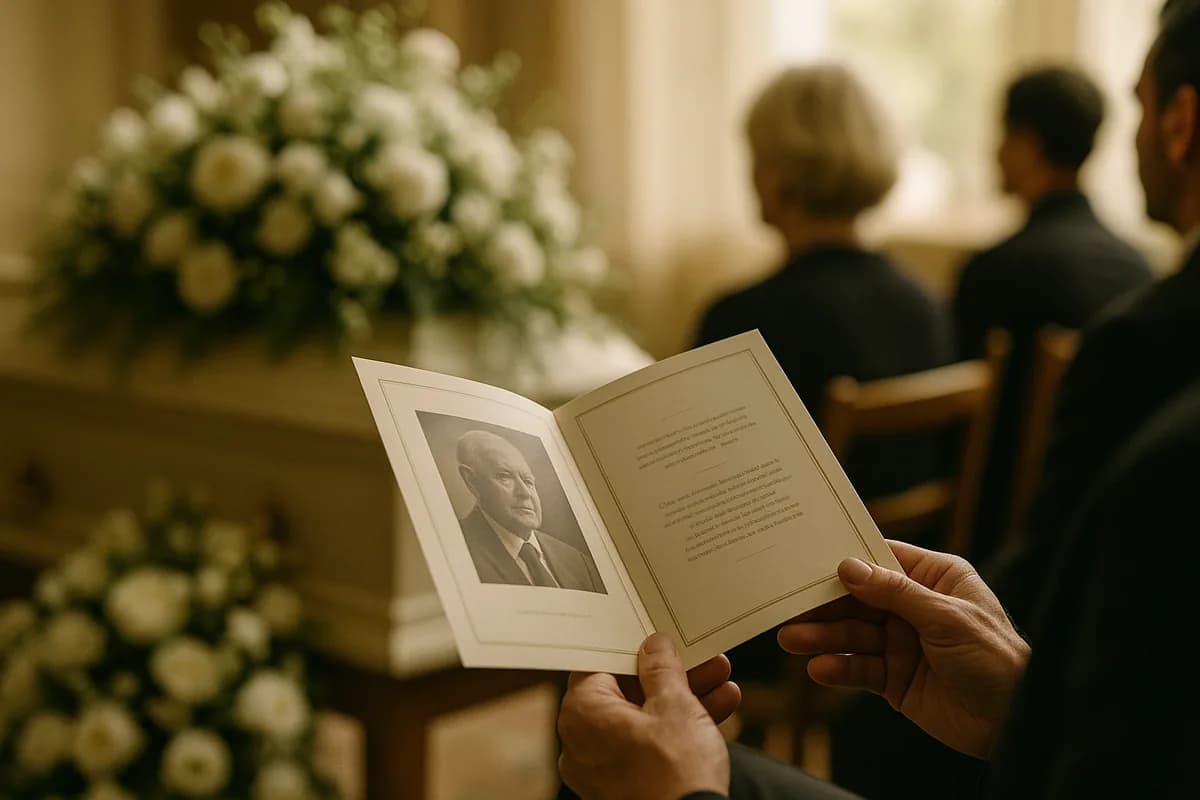
The version printed inside a funeral program is often a condensed version of the full obituary — the life story and character, without the full list of survivors or the donation details, which guests already have. The newspaper or funeral-home website carries the complete version. Write the full obituary first, then trim it gently for the program. Our guide on what to include in a funeral program shows how the biography sits alongside the other sections.
How long should an obituary be?
Most run 200 to 400 words. Newspapers may charge by the line, so confirm any limits before writing. A program version is often shorter still. For a parent, our obituary for a mother has ten complete examples, and there are sets for a husband, a brother and a grandfather.
What is the difference between an obituary and a death notice?
A death notice is a brief paid announcement with the essential facts and service details. An obituary is longer and tells the life story. Many families publish both. If you only need to share the news and the service details, start with our funeral announcement examples.
Who should be listed as survivors?
Typically the spouse, children and their spouses, grandchildren, and siblings, followed by those who preceded them in death. Families vary in how far to extend the list; include whoever the family feels belongs.