The Tribute Journal
Funeral Closing Remarks: 8 Examples (+ Closing Prayers and Blessings)
Funeral closing remarks are the last words of the service: a thank-you to everyone who came, a final thought about the person, and directions for what happens next. They usually take one to three minutes and are given by the officiant or a family member, often followed by a closing prayer or blessing.
Below are eight closing remarks to read or adapt, traditional closing blessings, and a checklist of what to mention. For the opening of the service, see our funeral welcome speech examples.
What to include in closing remarks
- Thank people. Guests, speakers, musicians, the funeral home, anyone who helped.
- One last thought. A sentence about who the person was or what they'd want for you.
- What's next. The committal, the procession, the reception or repast.
- A closing prayer, blessing or moment of silence, if it fits the family's faith.
- Dismissal. How and when guests should leave.
8 funeral closing remarks examples
1. Closing by a family member
On behalf of our whole family, thank you. Thank you for your cards, your meals, your stories and your presence today. [Name] loved a full room, and [he/she] would have loved this one. Please join us at [place] after the service, where we'll share lunch and more memories.
2. Closing by an officiant
We have remembered [Full name] with gratitude, and we have shared our grief. As we go from this place, may we carry [his/her] kindness into our own lives. Please remain standing for the blessing.
3. Closing at a celebration of life
If there's one thing [Name] taught us, it's that a good story deserves a good audience. So let's keep telling them. Food and drinks are [location]; the photo boards are by the door, and we'd love for you to write a memory card before you leave.
4. Closing before a graveside committal
This concludes the service here. The family invites everyone to join the procession to [cemetery] for a short committal. Please follow the funeral home staff, who will guide the cars.
5. Closing with a moment of silence
Before we leave, let's take a moment of silence to remember [Name] in our own way. [Pause.] Thank you. Please go gently, and look after one another.
6. Closing for a veteran
Thank you for honoring [Full name] today, for [his/her] service to our country and to all of us. The family invites you to [place] after the service.
7. Short closing (20 seconds)
Thank you for being here today. The family invites you to [place] for refreshments. Please drive safely.
8. Closing for a livestreamed service
To everyone here, and to everyone watching from home: thank you. Your messages have meant more than we can say. Those of you in the room are welcome at [place]; those of you online, please keep sending your memories to the family.
Traditional closing blessings and prayers
A benediction is, in Wikipedia's words, "a short invocation for divine help, blessing and guidance, usually at the end of worship service." Three often used at funerals:
The LORD bless thee, and keep thee: The LORD make his face shine upon thee, and be gracious unto thee: The LORD lift up his countenance upon thee, and give thee peace.
This is the Aaronic blessing, Numbers 6:24–26 in the King James Version (Bible Gateway).
Eternal rest grant unto [Name], O Lord, and let perpetual light shine upon them. May they rest in peace. Amen.
May the memory of [Name] be a blessing to all who knew [him/her], today and always.
For more choices by tradition, see our funeral prayers.
After the closing
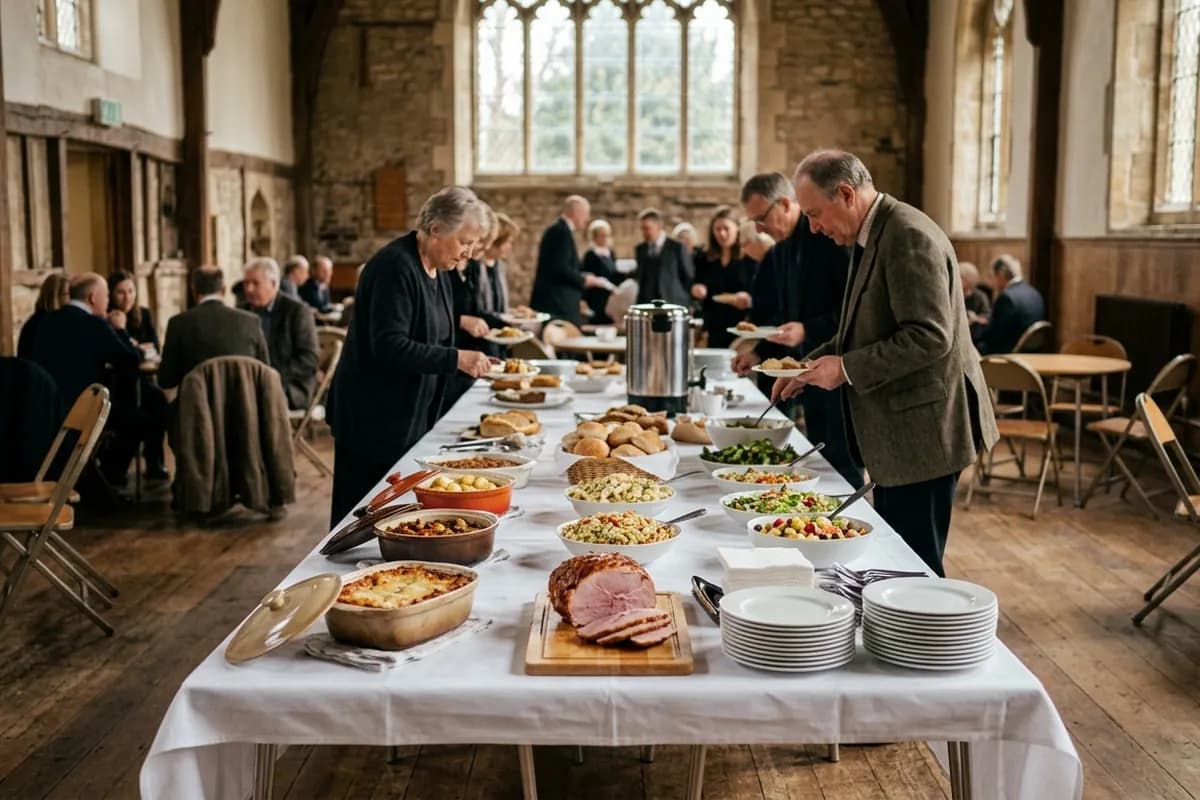
Guests usually leave quietly, often row by row as ushers or funeral home staff direct; Emily Post's service etiquette is a good reminder that the service "requires a respectful presence." Later, families often send printed thank-you notes; see our funeral acknowledgements for wording, and our funeral repast guide for the meal afterward.
Print the closing in the program
Many programs list the closing prayer or blessing at the end of the order of service, so guests can follow along. If you'd like help putting the program together, our designers can turn your wording into a printed program, often the same day. Start your program.
Common questions
What do you say at the end of a funeral?
Thank everyone for coming, share a last short thought about the person, explain what happens next (committal, procession or reception) and close with a prayer, blessing or moment of silence.
Who gives the closing remarks at a funeral?
The officiant at a religious service, or a family member or close friend at other services. Often it's the same person who gave the welcome.
What is a good closing blessing for a funeral?
The Aaronic blessing from Numbers 6:24–26 ("The LORD bless thee, and keep thee") is widely used. Eternal Rest is common at Catholic services.
How long should closing remarks be?
One to three minutes, including the blessing. Keep the directions simple so guests know exactly where to go.