The Tribute Journal
Celebration of Life Program: What to Include (+ Wording)
A celebration of life is not a funeral, and its program should not read like one. There is no liturgy to follow, often no casket in the room, and the tone is gratitude rather than grief. That freedom is lovely — and it is also why families stall on the program. Without a fixed order of service to fill in, it is hard to know what belongs on the page at all.
This guide walks the printed piece panel by panel, with wording you can copy directly. For the card that goes out beforehand, see celebration of life invitations. If you are still deciding what the gathering itself will look like, our celebration of life ideas covers the event; this covers the paper people hold during it.
What a celebration of life program includes
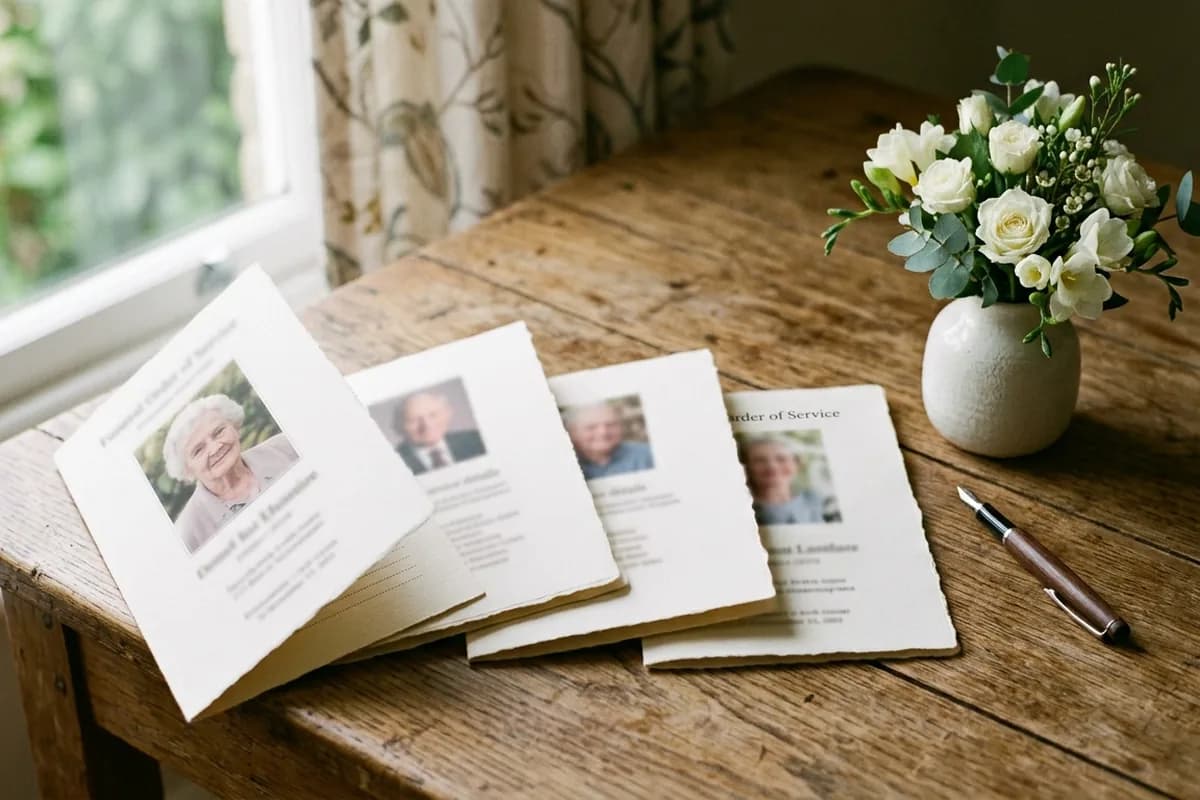
Six elements, and you can drop any of them. A single folded sheet handles all six comfortably.
- Cover — a warm heading, their name, and years (many families use years only, not full dates)
- A line that sounds like them — a quote, lyric, or something they actually said
- Gathering details — where, when, who is hosting
- Running order — what will happen, in sequence, without formal labels
- Life story or highlights — a short narrative, or a bulleted "things she loved" list
- Thanks and what comes next — the reception, a donation line, a request
Cover wording that is not "In Loving Memory"
"In Loving Memory" is perfectly fine, but it belongs to the funeral register. These read warmer:
- A Celebration of the Life of Patricia "Patty" Nolan
- Celebrating Ray Kowalski · 1948 – 2026
- Remembering Diane Ellis, With Love and Laughter
- A Gathering to Honor Samuel Oyelaran
- For Nana — Ruth Adebayo, 1936 – 2026
- Marisol Vega · Beloved, and Loud About It
A nickname in quotation marks does more work than any adjective. If everyone called him Buster, the cover should say Buster. For lines to sit beneath the name, our in loving memory quotes are grouped by length and tone.
The running order
This is where a celebration of life program most differs from a funeral one. Skip "Processional" and "Benediction". Name what is actually happening, in the words a friend would use:
- Welcome — Meg Nolan
- A song Patty played too loudly — "Here Comes the Sun"
- Photos, start to finish
- Open floor — tell us a story about her
- A reading — "Do Not Stand at My Grave and Weep"
- A few words — Claire Nolan
- A quiet minute, for whoever needs it
- Thank you, and please stay for food
Two practical notes. First, if you are opening the floor to anyone, print it — people need warning to think of something. Second, put a rough end time on the page if there is a reception after; guests relax when they know the shape of the afternoon. If you would rather follow a more traditional sequence, our funeral order of service examples include a celebration-of-life version alongside six others.
The life story, done briefly
A full obituary can feel heavy here. Two lighter formats work better on a celebration of life program.
Option 1 — a short warm paragraph
Patty was born in Madison and never really left, which she considered a decision rather than an accident. She taught fourth grade for thirty-one years, grew tomatoes with more confidence than skill, and knew the name of every dog on her street. She is survived by her daughters Meg and Claire, four grandchildren, and a great many former students who still write.
Option 2 — the list
- Things Patty loved: her garden, sharp cheddar, Motown, arguing about baseball, other people's dogs
- Things Patty did not love: small talk, decaf, being photographed
- Places she went back to: Door County, the same cabin, every August, for forty years
The list format is remarkable at a celebration of life. It makes people smile in the middle of a hard afternoon, and it is far easier to write than prose when you are grieving. If you would rather write a full life story, our obituary examples show several lengths.
Back panel: thanks, and what happens next
Patty asked that nobody wear black and that somebody bring good cheese. We have honored both requests. Thank you for being here — it would have meant everything to her, and it means everything to us.
Add the practical lines beneath it: where the reception is, and where donations should go if the family has asked for them. For phrasing that does not sound like a fundraising letter, see our guide to in lieu of flowers wording.
Format and quantity
- Single folded sheet (bifold) — four panels, right for almost every celebration of life
- Flat card — if the running order is short and you want something guests can pocket
- Booklet — only if you have many photographs or a long list of speakers
- How many — expected guests plus about 20%; people take a second copy for someone who could not come
- Paper — matte, not glossy; photographs read better and there is no glare in a bright room
Color is where a celebration of life program earns its name. Nothing requires it to be ivory and gray. If she wore yellow, print yellow.
Common questions
What is the difference between a celebration of life program and a funeral program?
The elements are nearly the same — cover, order of events, life story, thanks — but the tone and vocabulary differ. A celebration of life program avoids liturgical labels, often uses years rather than full dates, allows color and humor, and frequently replaces a formal obituary with a short warm paragraph or a list of what the person loved.
Do you need a program at a celebration of life at all?
You do not, but guests appreciate one. It tells people what is coming, spares them asking, gives speakers a running order to follow, and becomes the keepsake most families are glad they have a year later.
How long should a celebration of life program be?
One folded sheet is right for most. Around 300 to 450 words total, spread across four panels, plus photographs. Longer than that and people stop reading in the room.
Should the program mention how they died?
Only if the family wants it mentioned. Many celebration of life programs say nothing about cause of death at all. If a charity is involved because of an illness, the donation line usually carries that context on its own.
Can you put photographs inside a celebration of life program?
Yes, and you should. A small collage across one inside panel or the back is common. Choose four to eight images spanning different decades rather than many from one period.