The Tribute Journal
Cremation vs Burial: Cost, Process, and How to Choose
Cremation is almost always less expensive and more flexible; burial gives you a fixed place to return to. That is the whole comparison in one line. Everything below is detail that helps you decide which of those two things matters more to your family.
It is also worth knowing that this is no longer an unusual question. Cremation overtook burial as the more common choice in the United States during the mid-2010s and has continued to rise since — both the National Funeral Directors Association and the Cremation Association of North America publish the current national rate. If you are leaning toward cremation, you are with the majority.
The cost difference, honestly
NFDA's most recent published medians put a funeral with viewing and burial at about $8,300, and a funeral with cremation at about $6,280. Both figures are for the funeral home's services and merchandise only.
That gap looks modest — roughly $2,000 — but it understates the real difference, for two reasons.
- Those medians exclude cemetery costs entirely. Burial adds a grave plot, an opening-and-closing fee, and usually a headstone or marker. Together those commonly add several thousand dollars more, and vary enormously by region and cemetery.
- The $6,280 cremation figure assumes a full service. Direct cremation — no viewing, no ceremony at the funeral home, remains returned to the family — is far cheaper, often a small fraction of that. Many families then hold their own memorial gathering later at no funeral-home cost at all.
So the practical spread is not $2,000. It is closer to the difference between a few thousand dollars and well over ten, depending on how much service you want around either choice. Ask for the itemized list and compare line by line rather than package to package.
One cost that does not change either way is the printed program, which is a fixed and comparatively tiny line item — our breakdown of what a funeral program actually costs covers the range.
What actually happens in each
Burial
- The body is prepared, and embalmed if there will be a public viewing or a delay
- It is placed in a casket, which the family selects and owns
- A service is held — at a funeral home, a place of worship, or graveside
- A procession travels to the cemetery for the committal
- The grave is closed, and a marker is set later, usually a few months afterward
Cremation
- The body is held while permits and authorizations are completed — this typically takes a few days and is set by state law, not the funeral home
- Cremation takes place in a licensed crematory
- Remains are returned to the family, usually within one to two weeks, in a temporary container unless an urn has been chosen
- The family decides what happens next: interment in a plot or niche, scattering (our guide to scattering ashes covers the legal rules and what to say), division among relatives, or keeping them at home
- A service can happen before the cremation, after it, or not at all
That last point is the real difference in feel. Burial has a deadline; cremation does not. Families who need time — because relatives must travel, or because nobody can face planning a service in the first week — often choose cremation for that reason alone. Our guide to funeral vs memorial service explains how the timing changes once the body is no longer waiting.
What the Bible says about cremation vs burial
The Bible does not forbid cremation. There is no verse that prohibits it and no verse that commands burial. What scripture describes is the burial custom of its time and place — the practice of the culture, recorded rather than prescribed.
The passages usually raised on either side are these. Genesis 3:19 ("dust thou art, and unto dust shalt thou return") is read by some as favoring burial and by others as describing exactly what cremation accomplishes. 1 Corinthians 15 teaches a resurrection body that is not the physical one that died, which many Christians take as settling the matter: the condition of the remains does not constrain God.
Where denominations differ, they differ on emphasis rather than permission:
- Catholic — cremation is permitted, and has been since 1963. The Church asks that remains be interred in a cemetery or columbarium rather than scattered or kept at home, and that they be treated with the same reverence as a body
- Most Protestant denominations — no restriction; the choice is left to the family
- Eastern Orthodox — generally discourages or declines cremation, with burial strongly preferred
- Judaism — traditional Jewish law calls for burial, and Orthodox practice does not permit cremation; Reform practice varies
- Islam — burial is required and cremation is not permitted
- Hinduism and Sikhism — cremation is the traditional and expected practice
If the family's tradition matters here, the person to ask is your own clergy member, not a website. Practice varies by congregation more than any summary can capture.
What you still need either way
Whichever you choose, the gathering itself looks much the same, and needs the same things:
- Someone to lead it — clergy, a celebrant, or a family member
- An order of events guests can follow
- A printed program — the keepsake most families are glad they have a year later
- Readings, music and a eulogy
- Somewhere for people to go afterward
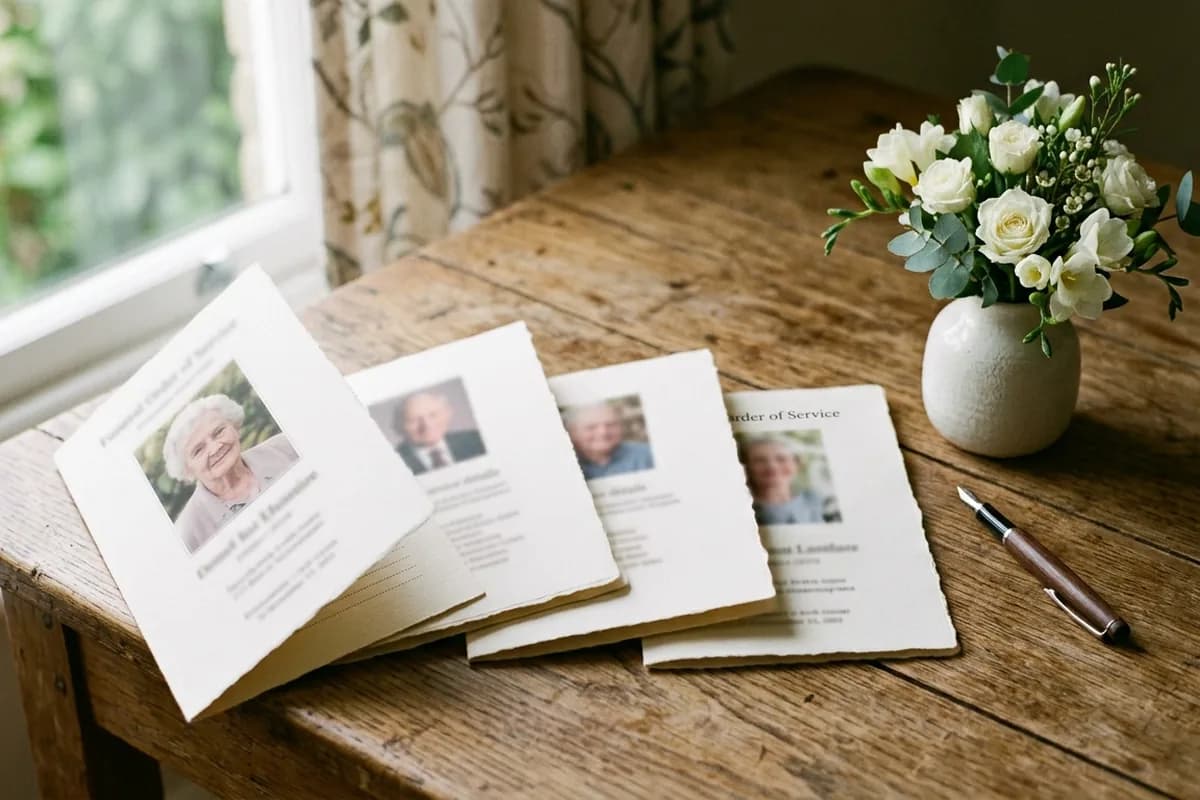
For cremation families in particular, the program often does more work than it would at a burial: with no casket in the room, the photograph on the cover and the life story inside become the focus of the gathering. Complete examples laid out panel by panel are in our sample funeral programs.
How families actually decide
In practice it comes down to three questions, and the first one usually settles it.
- Did they say what they wanted? If so, that is the answer. Write it down and stop deliberating — this is the one decision where you do not have to carry the responsibility yourself.
- Does the family need a place to visit? Some people grieve by going somewhere. A grave, or a niche, or a plot with a marker gives them that. Scattering does not, and some relatives feel that absence sharply for years. If opinions differ, interring cremated remains in a plot or columbarium gives you both.
- What can you afford without borrowing? A more expensive funeral is not a more loving one. Nobody at the service will know what anything cost, and a family that goes into debt for a casket is not better off for it.
If a headstone or marker is part of the decision, our guide to headstone inscriptions covers the wording and the practical limits before you commit to anything carved. And if you are at the very start of this and need to know what has to happen this week versus what can wait, use the funeral planning checklist.
One last thought worth holding on to: this is a decision about a body, not about a person. Whichever you choose, the part that matters — the gathering, the stories, the people in the room — is identical. Ideas for shaping that part are collected in our memorial service ideas.
Common questions
Is cremation cheaper than burial?
Yes, in almost every case. NFDA's published medians show about $6,280 for a funeral with cremation versus about $8,300 with viewing and burial, and those figures exclude cemetery costs — which burial adds and cremation may not. Direct cremation, without a funeral-home service, costs far less again.
What does the Bible say about cremation vs burial?
Nothing that forbids cremation. Scripture describes the burial customs of its time rather than commanding them, and 1 Corinthians 15 teaches a resurrection body distinct from the one that died. Denominations differ in emphasis: Catholic and most Protestant churches permit cremation, Eastern Orthodox generally discourages it, and Orthodox Judaism and Islam call for burial.
How long does cremation take?
The cremation itself takes a few hours, but the timeline families experience is set by paperwork: permits and authorizations usually take several days, and remains are typically returned within one to two weeks.
Can you have a viewing if you choose cremation?
Yes. A viewing or wake can be held before the cremation, which many families do precisely so relatives can say goodbye. It does add embalming and casket rental costs, so ask for those as separate line items.
Can cremated remains be buried?
Yes, and it is common. Cremated remains can be interred in a standard plot, in a smaller urn plot, or placed in a columbarium niche. This is the usual compromise when part of the family wants somewhere to visit and part prefers cremation.
Is cremation more environmentally friendly than burial?
Neither is clearly better. Cremation uses fuel and releases emissions; conventional burial uses land, a manufactured casket, a concrete vault, and often embalming chemicals. Families weighing this specifically should look at green or natural burial, which avoids embalming and vaults, rather than assuming cremation is the greener option.