The Tribute Journal
Funeral Planning Checklist: Every Step, in Order

Planning a funeral means making around seventy decisions in about four days, while grieving, usually while also answering the phone every ten minutes. Nobody is ready for it. The list below breaks the whole thing into the order things actually happen, so you can look at one small section at a time instead of the whole mountain.
The first few hours
- Get the legal pronouncement of death — the hospital, hospice, or attending physician handles this. At home with no hospice, call 911.
- Notify immediate family and one or two close friends. Ask one of them to spread the word further.
- Look for any pre-arrangement paperwork, prepaid funeral plan, or written wishes. Check the safe, filing cabinet, and email.
- Arrange transport of your loved one into the care of a funeral home or crematory.
- Care for anyone dependent — children, elderly parents, pets — and for yourself. Eat something.
Nothing else on this page has to happen today. Everything below can wait until tomorrow.
The first two or three days
Decisions that set everything else
- Burial or cremation — check for stated wishes first; this decides most of what follows.
- Choose the funeral home, and ask for the itemized General Price List. The FTC Funeral Rule entitles you to it, and prices vary widely between homes in the same town — the National Funeral Directors Association puts the median funeral with viewing and burial at about $8,300, so a few calls genuinely change the number.
- Set the date, time, and place of the service. Confirm with the officiant, the cemetery or crematory, and the venue before telling anyone.
- Decide the shape of the service: traditional funeral, memorial service, graveside only, or celebration of life.
- Request 10 to 12 certified copies of the death certificate. Banks, insurers, and the DMV each keep one.
If you are unsure what shape the service should take, our guide to memorial service ideas and celebration of life ideas lay out the differences with examples.
The writing tasks
- Write the obituary and send it to the newspaper and funeral home — most papers have a same-day or next-day deadline.
- Choose who will give the eulogy and who will do any readings. Ask early; people need time.
- Gather photographs — the cover portrait, and any others for a slideshow or the inside of the program.
- Decide on charitable donations in place of flowers, and settle on the exact wording.
Two of those have their own guides: how to write an obituary and how to write a eulogy. For the donation line, "in lieu of flowers" wording has ready examples you can adapt in a minute.
The week of the service
- Finalize the order of service with the officiant — hymns, readings, speakers, music, and the sequence.
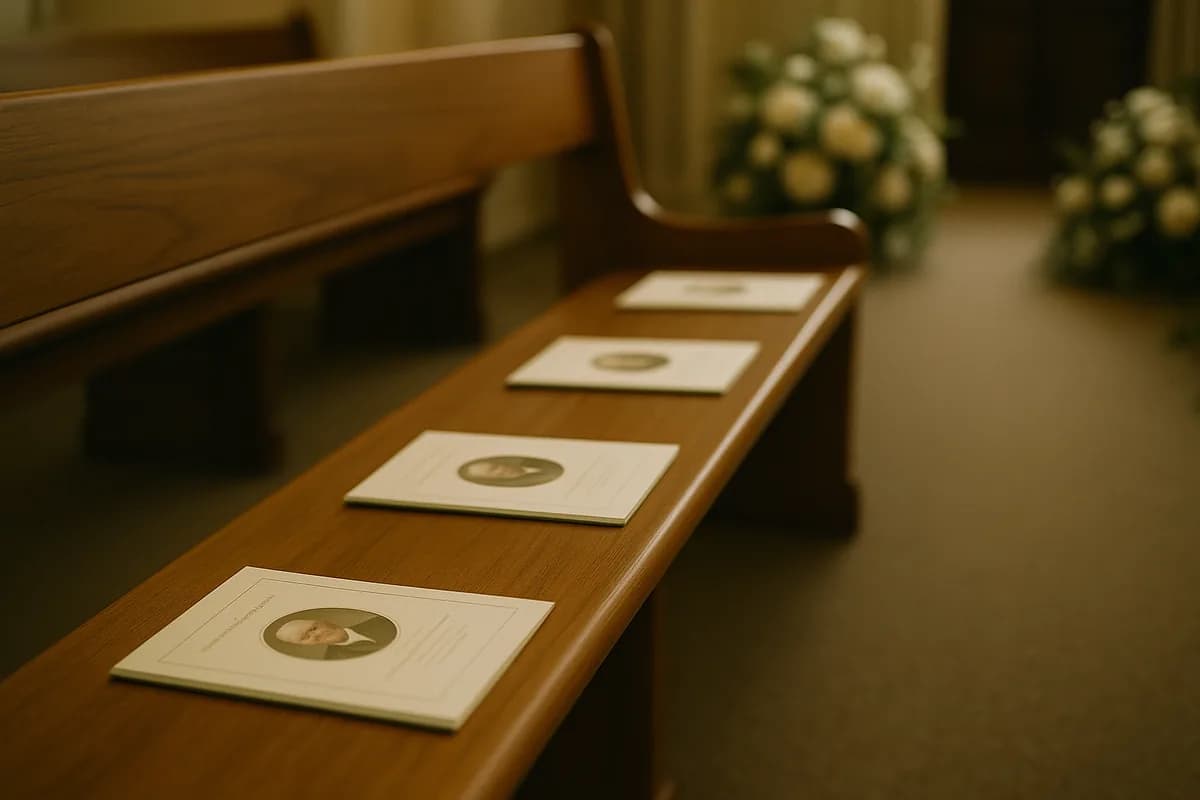
- Have the funeral program designed and printed. Order 10 to 15 percent more than your expected guest count; couples share, but people also take one home.
- Choose clothing, and pass on any jewelry decisions to the funeral director.
- Confirm pallbearers — usually six — and let them know where and when to arrive.
- Arrange flowers for the casket or memorial table.
- Book the reception: venue, food, and who will host it.
- Arrange travel and lodging for family coming in from out of town.
- Ask someone to stay at the house during the service. Empty homes and published funeral times are a known burglary risk.
The day before
- Proofread the program one more time — every name, every date, out loud, with a second person.
- Print or collect the programs and fold them.
- Pack a box: programs, guest book and pen, photographs, memorial table items, tissues, water.
- Confirm arrival times with the officiant, speakers, pallbearers, and musicians.
- Set out clothing for everyone in the household.
A guest book belongs in that box too — it becomes your list for thank-you notes later, and you will be glad you have it.
The day of the service
- Arrive 45 to 60 minutes early with the family.
- Set out programs at the entrance, along with the guest book and photographs.
- Ask someone reliable to hand out programs and greet guests — it is a real job, and it is a kind one to give to someone who wants to help.
- Designate someone to accept flowers, cards, and food.
- Eat something before the reception. You will forget otherwise.
The weeks after
- Send thank-you notes for flowers, donations, food, and acts of service — two to three weeks is customary, and later is fine.
- Notify Social Security, banks, insurers, pension providers, and the DMV.
- File any life insurance claims.
- Cancel subscriptions, memberships, utilities, and phone service.
- Close or memorialize social media accounts.
- Order the headstone or marker if you are having one — engraving often takes two to three months.
- Keep a few extra programs. Families ask for them years later.
Our guide to funeral thank you cards has wording for every situation, including donations and money.
What you can hand to someone else
People keep asking what they can do, and most families say "nothing, thank you." Give them something instead. These four jobs are easy to hand over completely: fielding phone calls, coordinating food, arranging travel for out-of-town family, and staying at the house during the service. Handing over four jobs is the difference between a hard week and an impossible one.
How long does it take to plan a funeral?
Most services happen three to seven days after the death. A memorial service without the body present can be scheduled weeks or months later, which gives family time to travel and gives you room to breathe.
What is the first thing to do when someone dies?
Get the legal pronouncement of death, then notify immediate family, then arrange transport into the care of a funeral home. Everything else can wait until the next day.
How many death certificates should I order?
Ten to twelve certified copies. Banks, insurers, pension providers, the DMV, and title companies each keep one, and ordering more later costs more per copy.
How many funeral programs should I print?
About 10 to 15 percent more than your expected guest count. Couples often share one, but many guests take a program home as a keepsake, and family will want extras afterwards.